Here's the English version of the article, professionally formatted and ready for publication:
---
# The Complete Guide to Cosmetic Manufacturing Process: From Formulation to Finished Goods
**Cosmetic manufacturing is a rigorous, systematic project**—far more than simple mixing and filling. The core production chain can be summarized as:
> **Formulation Development → Raw Material Procurement & Inspection → Production Preparation → Product Compounding → Semi-finished Product Testing → Filling & Packaging → Finished Product Inspection → Warehousing & Logistics**
Below is a detailed breakdown of the standard manufacturing process, giving you an in-depth look at the professional control behind every step.
## Part I: Preliminary Preparation & R&D Design
*(The Product Birth Phase)*
### 🔬 Formulation Development
Based on market positioning, define the **functional direction** (moisturizing, anti-aging, repairing, etc.), **texture type** (serum, lotion, cream, etc.), and **fragrance profile**. The R&D team designs a scientific formula, followed by small-batch validation, stability testing, and safety assessments before proceeding to the next stage.
### 📦 Raw Material Procurement & Inspection
Raw materials are sourced from an approved supplier list (including **water, oils, waxes, active functional ingredients, surfactants, etc.** ). All incoming materials must undergo **component identification, microbial indicator testing, and physicochemical property analysis** to ensure each batch meets quality standards before being accepted into inventory.
## Part II: Core Compounding & Processing Technology
*(The Manufacturing Phase)*
### ⚖️ Weighing & Pre-treatment
Accurately **weigh** each raw material component according to the formula. Oil-phase ingredients (such as oils and waxes) are typically **heated to 70–85°C** to melt them into a uniformly liquid state, preparing them for subsequent mixing.
### 🔄 Mixing, Emulsification & Homogenization
The **aqueous phase** and **oil phase** are sequentially loaded into the emulsification tank. Through **high-speed stirring and homogenization**, the two phases are thoroughly blended to form a stable, fine emulsion or cream base—this is the core step that determines the product's skin feel and stability.
### 🌡️ Temperature Control & Post-processing
- **Cooling & Additive Incorporation**: After emulsification, the batch is gradually cooled. When the temperature drops to **40–50°C**, heat-sensitive ingredients such as **fragrances, preservatives, and active components** are added to prevent degradation from high temperatures.
- **Vacuum Deaeration**: Certain products undergo vacuum deaeration to remove air bubbles introduced during mixing, ensuring a uniform appearance.
- **Aging / Maturation**: The semi-finished product is left to stand at **25±2°C** for a period to allow the system to further stabilize and mature.
## Part III: Filling, Packaging & Quality Control
*(The Finished Product Output Phase)*
### 🧼 Environmental Preparation
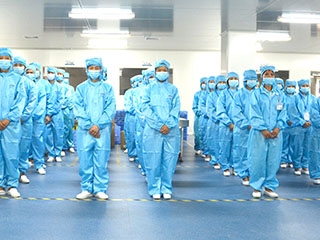
All operators must undergo **strict sanitization** and wear cleanroom garments. The filling and packaging processes must be carried out in **GMP-compliant cleanrooms (Class 100,000 / ISO 8)** to prevent microbial contamination at the source.
### 🏺 Filling & Packaging
The tested and approved semi-finished product is quantitatively dispensed into cleaned and sterilized containers (bottles, tubes, jars, etc.) via automated filling equipment. This is followed by capping, labeling, cartoning, and shrink-wrapping.
### ✅ Full-Process Quality Control
Finished products undergo comprehensive **batch release testing**, including:
- **Physicochemical parameters** (pH, viscosity, heat/cold stability, etc.);
- **Heavy metal testing** (lead, mercury, arsenic, etc.);
- **Microbiological testing** (total bacterial count, yeast & mold, heat-tolerant E. coli, etc.).
Only after all tests comply with the *Safety and Technical Standards for Cosmetics* can the batch be cleared for warehousing and authorized for market distribution.
**Every step in cosmetic manufacturing matters—quality and safety are non-negotiable.** The closed-loop quality control from R&D to shipment is what sets premium products apart.
---
> *For more information on OEM/ODM collaboration processes, regulatory compliance, or quotation assessments, feel free to follow us or reach out directly.*
The Complete Guide to Cosmetic Manufacturing Process: From Formulation to Finished Goods
2026-09-09
Cosmetics OEM
Category:
Cosmetics OEM
Recommended
You might also like
2026-09-09
#OEM vs. ODM vs. OBM: Which Contract Manufacturing Model Fits Your Brand Best?
#OEM vs. ODM vs. OBM: Which Contract Manufacturing Model Fits Your Brand Best?